
Traditional Indian Festive AI Photo Prompts: Sarees, Diya Lighting & Temple Architecture
Master traditional Indian festive AI photo prompts. Learn exact prompt terminology for Banarasi and Kanjeevaram sarees, diya candlelight bokeh, heritage temple stone architecture, and festive jewelry in Midjourney, Flux, and Gemini.
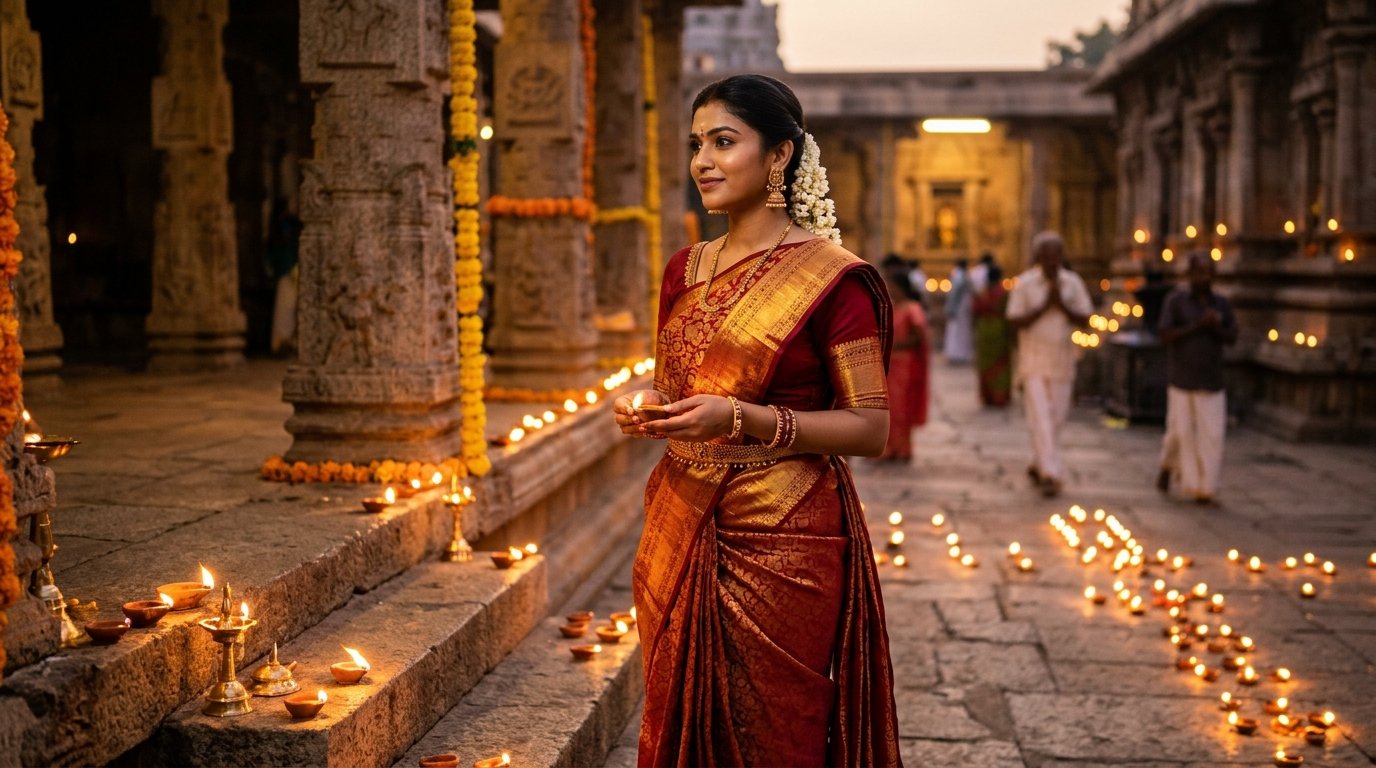
Traditional Indian festivals are a multisensory celebration of color, architectural grandeur, sacred illumination, and centuries-old artisanal craftsmanship. From the warm radiance of clay diyas during Diwali and Karthigai Deepam to the vibrant silks of festive weddings and temple celebrations, Indian cultural portraiture offers some of the most visually mesmerizing aesthetics in world photography. However, recreating authentic Indian festive imagery using generative AI has historically been one of the most frustrating challenges for prompt creators.
When western-centric AI models encounter a simplistic prompt such as 'Indian woman in a festival saree,' they frequently default to exaggerated Bollywood tropes, hyper-saturated costume collages, or generic orientalist fantasy styling. Human skin is often smoothed into artificial plastic, delicate jewelry morphs into melted yellow blobs, and sacred temple courtyards are replaced by generic Middle Eastern domes or cartoonish fairy lights. The issue is not that generative models lack the training data; rather, the models require precise, culturally grounded technical vocabulary to activate their most sophisticated weights.
Modern diffusion architectures—including Midjourney v6.1, Google Gemini (Imagen 3), and Flux.1—contain extensive photographic representations of authentic Indian handlooms, classical architectural masonry, and real candlelight physics. When you specify the exact weave of a handloom textile, the physical placement of brass oil lamps, the refractive characteristics of temple jewelry, and the warm spectral falloff of diya flames, these models synthesize breathtaking, museum-quality photographs indistinguishable from professional editorial features in Architectural Digest or Vogue India.
This masterclass guide provides a comprehensive blueprint for crafting authentic, respectful, and visually stunning Indian festive AI photo prompts. You will learn the exact terminology for regional handlooms, architectural settings, lighting techniques, and tested copy-and-paste prompt formulas for your creative projects.
Why generic cultural prompts fail in modern diffusion models
Most AI image models are trained on billions of image-text pairs scraped from global archives. When prompt instructions are broad or vague—such as 'traditional Indian clothing'—the cross-attention layers in the diffusion neural network activate the most common generic cluster in their latent space. This cluster is heavily weighted toward commercial stock photography, costume party photos, or theatrical films, resulting in over-accessorized, synthetic-looking figures. To unlock genuine photorealism, you must bypass the high-level category words and instruct the model with authentic artisanal and regional terminology. Specifying 'heavy crimson Kanjeevaram silk with pure gold zari pallu' or 'raw tussar silk kurta in ivory with subtle chikankari thread embroidery' immediately forces the model to synthesize specific physical textures, weaving patterns, and natural fabric drapes.
Decoding Indian handlooms: Banarasi, Kanjeevaram, and Chanderi
The soul of traditional Indian festival portraits lies in the rich materiality of its handwoven textiles. Each regional weave interacts with camera optics and lighting in distinct ways: 1. Kanjeevaram Silk: Woven from heavy mulberry silk and metallic gold threads in Tamil Nadu, Kanjeevaram sarees feature structured, crisp folds with high specular sheen and dense temple-border motifs ('korvai'). Use phrases like 'heavy structured Kanjeevaram pure silk saree, rich magenta and emerald green, dense gold zari brocade border, crisp fabric creases.' 2. Banarasi Silk: Originating from Varanasi, Banarasi sarees are famous for delicate floral Mughal-inspired motifs ('butis' and 'jaal') woven into fine silk. Use 'fine Banarasi brocade saree in deep crimson red, intricate antique gold floral zari motifs, fluid silk drape catching candlelight.' 3. Chanderi & Organza: For daytime festivals and summer celebrations, sheer, lightweight fabrics provide ethereal elegance: 'translucent pastel sage green organza saree, gossamer golden border, soft natural drape with delicate woven motifs.'
The physics of diya lighting: Simulating warm candlelight and bokeh
Illumination in Indian festivals is anchored by oil lamps ('terracotta diyas' and 'brass vilakkus'). A burning flame has a very low color temperature (approximately 1700K to 2000K), which casts an intimate, warm amber glow while leaving distant backgrounds in deep, mysterious twilight or moody blues. In generic prompts, AI tools often add harsh white light or digital sparkle overlays that ruin this sacred ambiance. To achieve authentic festive illumination, describe the light sources and their interaction with the surroundings: 'illuminated by dozens of glowing terracotta oil diyas, soft golden candlelight flickering on the subject\'s face, 2000K warm color temperature, low-key lighting with deep velvety shadows, dreamy circular candlelight bokeh in the dark background.' This instructs the model to create realistic inverse-square light falloff and authentic skin specular highlights.
Authentic architectural backdrops: Temple courtyards, stone carvings & havelis
A frequent failure in AI-generated Indian images is architectural confusion, where Hindu temple pillars are mistakenly merged with Mughal minarets or Persian arches. To establish grounded architectural coherence, name the specific historical style and building material: 1. South Indian Temple Architecture: Specify 'carved Dravidian granite temple pillars, weathered stone courtyard, stepped temple tank in the soft background, monolithic stone sculptures lit by oil lamps.' 2. Rajasthani Havelis & Courtyards: Specify 'traditional Shekhawati haveli courtyard, sandstone jharokhas with intricate lattice stonework, arched corridors with vintage brass lanterns.' 3. Festive Home Verandahs: For intimate, family-style scenes, specify 'traditional verandah with red oxide flooring, fresh brass urli bowl filled with water and floating marigold flowers, clay diya arrangements along the veranda steps.'
Prompting traditional Indian jewelry with surgical precision
AI models often struggle with complex jewelry, turning necklaces and earrings into amorphous yellow blobs if not properly specified. The secret is to describe the metal finish, the gemstone setting technique, and the specific jewelry pieces: 1. Temple Jewelry: Handcrafted from unpolished 22k gold featuring motifs of deities, peacocks, and temple bells: 'antique matte 22k temple gold necklace, traditional kasu mala coin chain, intricate jhumka earrings with tiny pearl drops.' 2. Kundan & Polki: Uncut diamonds set in refined gold foil: 'regal jadau kundan choker necklace with uncut polki gemstones and hanging emerald teardrops, matching maang tikka nestled in parted hair.' 3. Silver & Oxidized Jewelry: For rustic, bohemian, or tribal celebrations (such as Navratri garba): 'oxidized antique silver ghungroo choker, carved silver tribal cuffs, delicate nose pin catching soft side light.'
Floral decor and festive elements: Marigolds, rangoli, and brass urlis
Festive storytelling is elevated by authentic secondary props and environmental accents. A well-crafted Indian festival prompt should weave in recognizable cultural elements: 1. Marigolds ('Genda Phool'): 'vibrant yellow and deep orange marigold floral garlands cascading down weathered stone pillars.' 2. Rangoli: 'intricate hand-drawn colored powder rangoli with geometric floral patterns, outlined with small burning clay diyas.' 3. Brass Antiquities: 'vintage handcrafted brass urli filled with scented water, floating fresh jasmine blossoms and rose petals, glowing tea-light candles.' These sensory cues enrich the visual context, giving the image genuine emotional warmth and depth.
Tested Copy-and-Paste Prompt Formulas
Formula 1 — Cinematic Temple Evening (Midjourney / Flux): 'Cinematic medium portrait of an elegant 24-year-old South Indian woman standing beside ancient carved granite temple pillars at dusk. She is wearing a deep wine-red Kanjeevaram silk saree with heavy antique gold zari borders and matching blouse. Authentic temple jewelry, matte gold kasu mala and delicate jhumkas. Hundreds of small clay diyas illuminate the stepped stone floor with warm flickering 2000K candlelight. Soft golden facial highlights, creamy circular candlelight bokeh in the background, 85mm f/1.4 lens photography, photorealistic, natural skin pores, 16:9 aspect ratio --ar 16:9 --style raw.' Formula 2 — Intimate Diwali Courtyard (Gemini Imagen 3 / Flux): 'A serene portrait of a young Indian couple celebrating Diwali in a candlelit haveli courtyard. The woman wears a royal emerald green Banarasi silk saree with gold floral brocade; the man wears an ivory raw tussar silk kurta with subtle gold thread embroidery. They are gently placing a lit terracotta diya onto a colorful floral rangoli. Warm ambient candlelight from surrounding oil lamps, soft cinematic shadows, shallow depth of field, authentic photography, true-to-life Indian skin tones.'
Model benchmark: Midjourney v6.1 vs Google Gemini vs Flux.1
Different AI models exhibit distinct strengths when rendering Indian ethnic festivals: 1. Google Gemini (Imagen 3): Demonstrates exceptional native understanding of Indian cultural context, skin tones, and regional outfits without requiring extensive negative prompting. It renders authentic facial expressions and family warmth effortlessly. 2. Midjourney v6.1: Excels in cinematic atmosphere, moody color grading, dramatic chiaroscuro lighting, and volumetric smoke/haze around lamps. Use '--style raw' to keep skin textures natural rather than overly stylized. 3. Flux.1 (Dev): Unrivaled in macro textile details, rendering distinct silk weaves, individual metallic zari threads, and precise finger positioning when holding a delicate diya.
Common mistakes and cultural pitfalls to avoid
Avoid combining contradictory cultural markers in a single prompt. For example, do not mix Rajasthani mirror-work lehengas with South Indian Dravidian stone temple tanks unless intentionally creating fusion art. Never use generic buzzwords like 'Indian goddess' or 'exotic princess' as they lead to caricatured or mythological fantasy renders rather than authentic human portraiture. Always specify 'subtle, elegant makeup' or 'natural kajal eye lining' to prevent modern aggressive western contouring that clashes with classical festive aesthetics.
Frequently Asked Questions
How do I prompt realistic diya candlelight in Midjourney and Flux?
Specify 'warm 2000K candlelight from burning terracotta oil diyas, soft flickering key light, deep moody background, golden specular highlights on skin, and creamy circular bokeh.' Avoid generic words like 'bright lights' or 'neon glow' which wash out the intimate festive mood.
How do I ensure Indian silk saree fabrics look authentic instead of synthetic?
Name the exact regional weave: 'Banarasi gold brocade,' 'Kanjeevaram heavy mulberry silk with pure zari pallu,' or 'Chanderi silk-cotton.' Adding 'natural silk creases, structural drape, metallic thread sheen' helps the AI render physical fabric weight.
Can AI models generate accurate traditional Indian jewelry like jhumkas and kundan?
Yes, if you describe the specific style and gemstone setting rather than just 'gold jewelry.' Use terms like 'antique 22k matte gold temple jewelry with bell-shaped jhumkas' or 'jadau kundan choker with uncut polki stones.'
What camera lens settings work best for traditional Indian festive portraits?
An 85mm f/1.4 prime lens is the gold standard for festive portraits. It provides flattering facial compression, sharp focus on the jewelry and saree embroidery, and softens background diyas and floral decor into dreamy bokeh.
Which AI tool is currently best for Indian traditional photo prompts?
Google Gemini (Imagen 3) leads in cultural accuracy and authentic Indian skin tones, while Flux.1 leads in fabric micro-texture and hand details. Midjourney v6.1 remains the best for moody, dramatic cinematic lighting.
Put an idea into words.
Find a prompt, change a detail, and explore a new direction.
Explore prompts →