
Night Street & Cyberpunk Photography Prompts: Neon Glow, Reflections & Rain Effects
Master night street and cyberpunk photography prompts in AI. Learn how to prompt wet asphalt reflections, dual-tone neon lighting, volumetric mist, anamorphic flares, and rain effects in Midjourney, Flux, and Gemini.
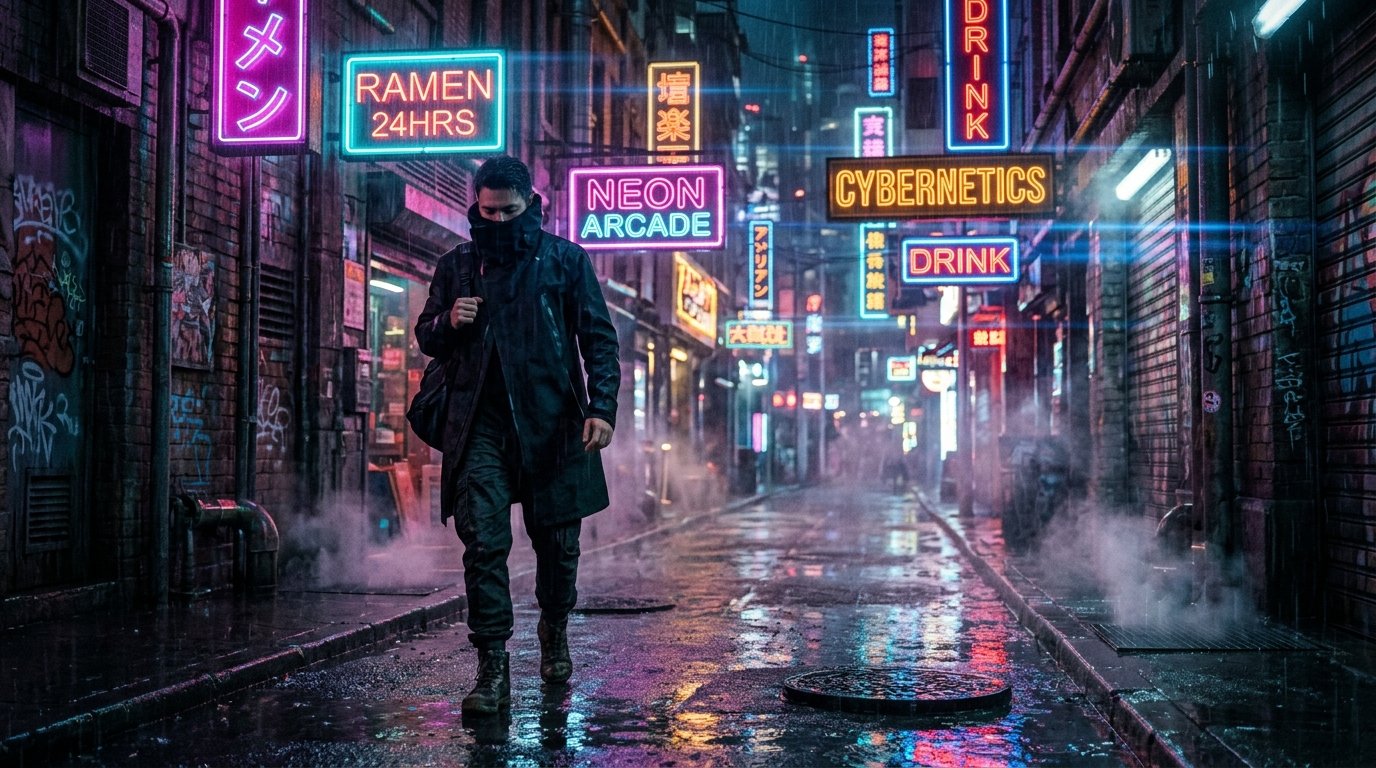
Nocturnal urban environments possess a mesmerizing visual rhythm that daytime photography can never replicate. When the sun dips below the horizon and metropolitan avenues are bathed in the artificial glow of neon signage, halogen streetlamps, and brake light streaks, cities transform into moody, high-contrast theatrical stages. From the rain-slicked cyberpunk alleyways of Shinjuku and Hong Kong to the atmospheric, steam-filled nocturnal streets of London and New York, night street photography is one of the most celebrated genres among visual creators.
However, rendering photorealistic night photography in generative AI models like Midjourney v6.1, Black Forest Labs' Flux.1, and Google Gemini (Imagen 3) is notoriously difficult for inexperienced prompt engineers. Generic prompts such as 'cyberpunk man in night street with neon lights' consistently result in muddy, crushed shadow blocks, cartoonish oversaturated glow halos, or flat digital renders that resemble video game cutscenes rather than authentic 35mm film captures.
Real low-light cinematography is governed by delicate optical principles: high dynamic range (HDR) latitude, specular highlight retention on wet surfaces, volumetric atmospheric diffusion from airborne mist and vehicle exhaust, and disciplined dual-tone color grading. When you understand how to communicate these physical lighting mechanics to an AI model, diffusion networks unlock breathtaking, film-grade nocturnal imagery filled with evocative narrative depth and razor-sharp reflection fidelity.
This masterclass guide breaks down the precise prompt architecture needed to master night street, rain-drenched, and cyberpunk aesthetics. You will learn the optical science of wet asphalt reflections, dual-tone chromatic balance, lens flare control, and tested copy-and-paste prompt formulas engineered for immediate creative results.
The physics of night photography: Dynamic range and shadow control
The primary failure in AI night generation is crushed black levels. Novice creators often ask for 'dark pitch black night,' which forces diffusion models to eliminate shadow detail, resulting in flat, unreadable silhouettes. Real nighttime photography relies on ambient city glow and artificial light spill to lift the deep shadows into rich, velvety charcoals and dark indigos. In your prompt, replace 'dark black night' with 'nocturnal urban scene with high dynamic range, soft ambient city light spill lifting deep shadows, rich contrast preserving mid-tone texture.' This instructs the generative model to render nuanced textures in clothing, brickwork, and asphalt even in the darkest areas of the frame.
The dual-tone color grading secret: Cyberpunk chromatic harmony
Authentic cyberpunk and neo-noir aesthetics are built on intentional chromatic contrast rather than a chaotic rainbow of neon. The most cinematic nighttime color palettes rely on complementary color temperature pairs: 1. Cyberpunk Classic (Magenta & Cyan): High-energy visual tension where vivid electric magenta signs illuminate one side of the subject's face while cool cyan ambient light provides fill illumination. 2. Industrial Noir (Amber & Teal): Warm tungsten amber streetlamps paired with cool deep teal shadows, evoking classic Ridley Scott cinema. 3. Tokyo Rain (Electric Blue & Crimson): Deep midnight blue skies contrasted against glowing red Japanese kanji neon lanterns. Specify these pairs directly: 'dual-tone cinematic color grading, vibrant electric magenta key light from storefront signage paired with cool cyan rim light, moody shadow falloff.'
Wet asphalt mechanics: Simulating mirror puddles and specular sheen
Rain is the ultimate multiplier of cinematic atmosphere because liquid transforms dull matte surfaces into dynamic light reflectors: 1. Wet Asphalt Texture: Dry asphalt absorbs light; rain-soaked asphalt acts as a glossy Fresnel reflector. Specify 'rain-soaked wet asphalt street, glistening textured ground reflecting distorted neon lights, specular puddle reflections.' 2. Puddle Ripples: Adding physical liquid interactions grounds the scene in reality: 'small rain puddles with concentric water droplets and ripples catching colorful neon reflections.' 3. Translucent Wet Sheen: For character styling, specify 'damp hair strands catching backlight, microscopic raindrops clinging to coat fabric, subtle skin sheen reflecting ambient city glow.'
Volumetric atmosphere: Street mist, steam, and environmental haze
Without atmospheric particles, artificial light appears harsh and artificial. In physical cinematography, directors use haze machines to catch directional light beams. In generative AI, you can simulate this optical phenomenon by describing airborne moisture: 1. Volumetric Light Cones: Specify 'visible light shafts cutting through urban mist, volumetric fog catching streetlamp glow.' 2. Urban Steam & Exhaust: 'Atmospheric steam billowing gently from manhole covers and ventilation grates, soft diffusion of neon light through mist.' 3. Rain Droplet Streaks: 'Fine nocturnal drizzle visible in the foreground, delicate motion-blurred raindrops catching golden streetlights.'
Camera optics and lens choices: 35mm vs Anamorphic streaks
Your choice of optical focal length dictates the intimacy and spatial drama of the nocturnal shot: 1. 35mm f/1.4 Lens (Environmental Immersion): The gold standard for night street photography. It captures wide architectural context, neon signage, and puddles while maintaining a crisp, three-dimensional subject separation. 2. Anamorphic Cinema Lens: Famous for oval-shaped bokeh and horizontal lens flare streaks: 'shot on anamorphic cinema prime lens, horizontal blue streak lens flare cutting across the frame, oval out-of-focus background bokeh.' 3. 85mm Telephoto Portrait: For intimate character close-ups: 'compressed background perspective, large creamy circular neon bokeh discs melting into the dark backdrop.'
Character wardrobing: Technical fabrics, silhouettes, and umbrellas
Character attire should complement the nocturnal environment: 1. Technical Outerwear: 'Long dark technical waterproof trench coat with subtle matte texture,' 'oversized hooded streetwear jacket catching neon rim light.' 2. Translucent Umbrellas: One of the most effective storytelling props in rain photography: 'holding a transparent vinyl umbrella covered in glistening water droplets, illuminated by soft neon glow from above.' 3. Wet Surface Highlights: Ensure the wardrobe interacts with the weather: 'rain-splattered lapels, damp collar, subtle water reflections along the shoulder seams.'
Tested Copy-and-Paste Night Street & Cyberpunk Formulas
Formula 1 — Tokyo Cyberpunk Rain Alley (Midjourney / Flux): 'Cinematic medium-wide shot of a lone young man in a dark modern technical trench coat walking down a rain-soaked neon-lit alleyway in Shinjuku at midnight. Electric magenta and cyan neon storefront signs reflect brilliantly across glistening wet asphalt and water puddles. Atmospheric street mist and volumetric steam rising from a manhole cover. Anamorphic lens flare, horizontal light streaks, rich shadow contrast without noise, 35mm f/1.4 photography, authentic film grain, photorealistic --ar 16:9 --style raw.' Formula 2 — Neo-Noir Transparent Umbrella (Gemini Imagen 3 / Flux): 'An atmospheric nocturnal street portrait of a contemplative young woman holding a transparent vinyl umbrella covered in fresh rain droplets. She is illuminated by the soft amber glow of a vintage telephone booth and the cool blue reflection of city traffic. Wet streets, soft circular raindrop bokeh, natural skin texture with subtle damp sheen, high dynamic range, cinematic documentary photography.' Formula 3 — Cyberpunk Night Market: 'A bustling futuristic cyberpunk night market alleyway, steam billowing from food stalls, vibrant holographic and neon lanterns in crimson red and gold. Rain-slicked cobblestone street, deep atmospheric depth, cinematic 50mm portrait.'
Model benchmark: Midjourney v6.1 vs Flux.1 vs Google Gemini for night scenes
1. Midjourney v6.1: The master of atmospheric neon, lens flare blooms, and cinematic mood. It handles wet street reflections with natural painterly beauty, but use '--style raw' to keep light sources physically grounded. 2. Flux.1 (Dev): Exceptional at fine detail resolution in low light. It renders crisp text on neon signs, distinct individual water ripples, and accurate fabric weave even in dimly lit zones. 3. Google Gemini (Imagen 3): Leads in rendering authentic human facial expressions and believable skin specular reflections under complex multicolored lighting.
Common mistakes to avoid in night prompts
Avoid stacking too many neon colors ('pink, blue, yellow, green, purple neon') as this creates an uncoordinated visual mess. Limit your palette to two dominant colors with one subtle accent. Never use 'pitch dark' or 'zero light' unless you want an empty image. Always anchor your scene with at least one believable light source: a streetlamp, a shop window, a phone screen, or a neon sign.
Frequently Asked Questions
How do I prompt realistic wet street reflections in AI photos?
Use descriptive physical terms: 'rain-soaked wet asphalt street, glistening textured ground reflecting distorted neon lights, small water puddles with specular highlights and rippling reflections.' Avoid generic phrases like 'shiny ground.'
What is the best color palette for cyberpunk AI prompts?
The classic dual-tone palette is electric magenta and cyan blue. Alternatively, tungsten amber paired with deep teal produces a grounded, industrial cinematic aesthetic.
How do I get anamorphic lens flares in Midjourney and Flux?
Include 'shot on anamorphic prime lens, subtle horizontal blue streak lens flare, oval out-of-focus background bokeh, cinematic 2.39:1 or 16:9 aspect ratio.'
Why does my AI night image look noisy or washed out?
Washed-out images occur when prompts ask for 'bright daylight' or lack shadow instructions. Specify 'high dynamic range, deep rich shadows with preserved mid-tone texture, atmospheric low-light photography.'
What focal length works best for nighttime urban street photography?
A 35mm f/1.4 lens is the most versatile. It captures broad environmental storytelling—signs, buildings, puddles—while keeping the human subject sharp with a natural, immersive perspective.
Put an idea into words.
Find a prompt, change a detail, and explore a new direction.
Explore prompts →