
Cinematic Couple Portrait Prompts: Emotion, Romantic Lighting & Natural Poses
Master cinematic couple portrait prompts in AI photography. Learn how to prompt natural romantic chemistry, golden hour rim lighting, candid body language, and pre-wedding aesthetics in Midjourney, Flux, and Gemini.
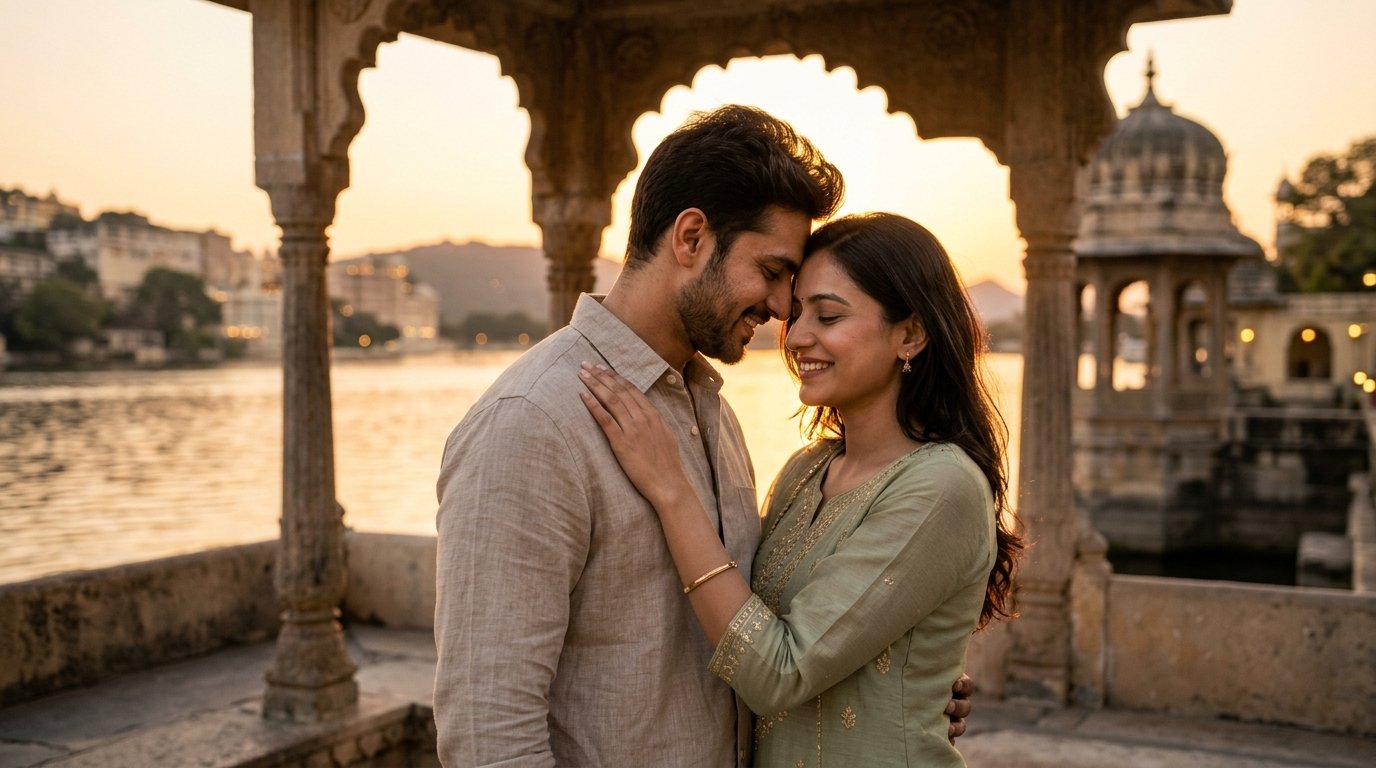
A memorable couple photograph is not merely a technical capture of two human faces standing adjacent to each other. It is an intimate visual story of emotional connection, shared stillness, subtle body language, and atmospheric lighting that evokes genuine cinematic romance. Whether you are creating pre-wedding visual concepts, editorial anniversary art, or cinematic couple storytelling on Prompt King, generating believable multi-subject chemistry in AI photography is one of the most demanding creative disciplines.
When generative diffusion models receive an unrefined prompt such as 'romantic Indian couple smiling at the camera,' they almost invariably produce rigid, catalogue-style poses. The two subjects often display synchronized mannequin grins, unnatural arm locks, merged fingers, or mismatched eye lines where neither person appears to exist in the same focal plane or emotional space. In worse scenarios, models suffer from identity bleed—cloning facial features from one subject onto the other.
Achieving Hollywood-grade intimacy requires translating physical directing techniques into prompt architecture. By specifying candid micro-interactions (such as laughter lines, a gentle hand resting on a collarbone, or a shared whisper), directional sunset rim lighting that halos both silhouettes, complementary textural wardrobe, and telephoto focal depth, you can coax AI models into synthesizing portraits overflowing with authentic warmth and emotional gravity.
This masterclass guide provides a step-by-step breakdown of how to engineer cinematic couple portraits across Midjourney v6.1, Black Forest Labs' Flux.1, and Google Gemini (Imagen 3). You will master multi-subject pose physics, golden hour optics, wardrobing rules, and battle-tested prompt formulas ready to copy and customize.
Why multi-subject prompts are notoriously difficult for AI models
To craft better couple prompts, you must first understand the mathematical friction inside diffusion architectures. Text-to-image models calculate spatial cross-attention between token words and latent pixel patches. When a prompt introduces two distinct subjects—e.g., 'a tall man with a beard' and 'a woman with a saree'—the attention maps often cross-pollinate. The model struggles to determine which outfit, hairstyle, or emotional descriptor belongs to which figure, resulting in attribute bleeding (e.g., beard texture appearing on the woman's jawline, or saree gold embroidery spilling onto the man's shirt). To prevent this confusion, your prompt syntax must establish spatial separation, assign descriptive attributes cleanly, and anchor both figures within a single coherent physical interaction.
The language of natural chemistry: Candids over posed stiffness
Stiff poses occur when prompt creators instruct subjects to look directly at the lens. In real cinematography, emotional resonance is built through candid, in-between moments: 1. Forehead-to-forehead or temple touch: Conveys deep emotional safety and quiet intimacy without requiring complex eye contact calculations. 2. Shared laughter ('The In-Joke'): Prompts for 'caught in mid-laughter, authentic crinkling around the eyes, candid unposed joy' break the plastic mannequin curse. 3. Direction of gaze: Have one subject look tenderly at their partner while the other looks softly toward the horizon or downward with a faint smile. This asymmetry immediately establishes a believable romantic narrative.
The golden hour lighting formula: Rim, backlight, and warm wrap
Lighting is the emotional heartbeat of romance in visual storytelling. Low-angle sunlight during the golden hour (the last 45 minutes before sunset) produces three optical effects that elevate couple portraits: 1. Warm Rim Light ('Hair Halo'): Sunlight placed directly behind the couple illuminates the edges of their hair, shoulders, and fabric, creating a luminous golden contour that separates them from the background. 2. Warm Color Temperature (2800K to 3200K): Flattering warm golden hues naturally soften skin imperfections and enrich skin tones. 3. Volumetric Flare and Haze: A touch of organic lens flare across the top of the frame softens digital contrast, creating the nostalgic, dreamy aesthetic of classic celluloid cinema.
Wardrobe coordination: Harmonious palettes without matching uniforms
A common amateur mistake is dressing both subjects in identical colors (e.g., two people wearing identical red outfits). This causes their bodies to visually merge into a chaotic block of fabric. Professional stylists use tonal harmony and textural contrast: 1. Complementary Neutrals: Pair a textured raw ivory or beige linen shirt on the male subject with a muted sage green, dusty rose, or terracotta ethnic dress on the female subject. 2. Textural Variety: Combine contrasting tactile materials—such as raw silk beside breathable cotton, or coarse wool beside flowing chiffon—so the generative model can render clear boundaries between the two bodies. 3. Muted Earth Tones: Earthy neutrals (olive, ochre, rust, slate, oatmeal) harmonize with golden hour landscapes and prevent color clipping.
Camera optics and focal plane management for two subjects
When photographing two people with a shallow depth of field, optical physics dictates that both faces must sit on approximately the same focal plane to remain sharp. If one person is standing slightly forward, an f/1.4 aperture will blur the other person's face into unreadable bokeh. In AI prompt engineering, specify an 85mm f/1.8 or f/2.2 aperture: '85mm f/1.8 portrait photography, both subjects in sharp focus, shallow depth of field with soft creamy background compression.' The 85mm lens flatters facial geometry, prevents wide-angle barrel distortion, and pulls the scenic background closer to the couple.
Scenic backdrops: Heritage pavilions, serene lakesides & misty hills
The setting should mirror and amplify the emotional tone: 1. Heritage Architecture: 'Ancient carved sandstone pavilion in Rajasthan, weathered jharokhas catching low evening sunlight, distant calm lake.' 2. Open Coastal Serenity: 'Misty golden hour coastal beach at low tide, wet sand reflecting amber sunset light, soft ocean spray in the far distance.' 3. Quiet Rural Countryside: 'Golden wheat field during sunset, warm evening breeze rustling wild grass, distant eucalyptus trees under a pastel twilight sky.' Avoid cluttered modern backgrounds that distract from the intimacy between the two subjects.
Tested Copy-and-Paste Romantic Couple Prompt Formulas
Formula 1 — Heritage Golden Hour Romance (Midjourney / Flux): 'Cinematic medium portrait of an affectionate young Indian couple at dusk in an ancient sandstone temple courtyard. The man wears a casual textured ivory linen shirt; the woman wears an elegant pastel olive chiffon saree with a delicate gold border. They are standing close, sharing an intimate candid laugh with natural crinkles around their eyes, his arm resting gently around her waist. Dreamy low golden sunset rim light glowing through their hair, warm amber illumination, soft circular sunset bokeh, 85mm f/1.8 lens photography, authentic skin pores and micro-texture, photorealistic --ar 16:9 --style raw.' Formula 2 — Quiet Coastal Intimacy (Gemini Imagen 3 / Flux): 'A tender, atmospheric portrait of a modern couple walking on a quiet beach during the golden hour. Gentle forehead-to-forehead embrace, soft serene expressions, eyes gently closed. Golden sunlight reflecting off tidal water, warm ocean breeze blowing fine strands of hair. Cinematic film color grade, soft contrast, natural subsurface scattering, candid documentary photography style.' Formula 3 — Urban Evening Walk: 'A moody, romantic street portrait of a young couple pausing under a warm vintage streetlamp on a damp European cobblestone street. Soft ambient glow, mist in the cool air, natural candid body language, trench coats, 85mm portrait, shallow depth of field.'
Model benchmark: Midjourney v6.1 vs Flux.1 vs Google Gemini for couples
1. Google Gemini (Imagen 3): Currently the most natural at synthesizing authentic emotional warmth, spontaneous candid expressions, and culturally authentic Indian facial structures without prompting fatigue. 2. Flux.1 (Dev): Exceptional at anatomical fidelity. When subjects embrace, Flux.1 is far less likely to generate merged fingers, extra knuckles, or deformed shoulders than older diffusion models. 3. Midjourney v6.1: The undisputed king of romantic color grading, volumetric haze, and Hollywood cinema aesthetics. Use '--style raw' to keep skin textures grounded and prevent default hyper-glamorization.
Troubleshooting multi-subject generation errors
If you notice attribute bleed (e.g., both people wearing the same jewelry or hair color), restructure your prompt with explicit spatial markers: 'On the left, a man wearing... On the right, a woman wearing...' If the model hallucinates extra limbs during an embrace, simplify the interaction: switch from a complex full embrace to a gentle touch on the shoulder or walking hand-in-hand. Specifying 'realistic hand anatomy, natural finger placement' in negative prompt weights keeps physical contacts clean.
Frequently Asked Questions
How do I prevent AI from generating fused hands and extra fingers in couple prompts?
Keep physical touch simple and contextualized: prompt for 'his hand resting naturally on her shoulder' or 'holding hands with natural finger interlock.' In Flux and Midjourney, use negative prompts like 'extra fingers, fused limbs, melted hands' and maintain a guidance scale between 5.0 and 7.0.
What is the best camera lens setting for AI couple portraits?
An 85mm f/1.8 prime lens is optimal. It ensures both subjects remain in crisp focus across their faces while blurring background distractions into smooth, cinematic bokeh without wide-angle facial distortion.
How can I get natural emotional expressions instead of fake smiles?
Avoid writing 'smiling couple.' Use cinematic behavioral cues like 'sharing a candid inside laugh, gentle crinkling around the eyes, soft forehead-to-forehead touch, calm serene gaze, authentic unposed moment.'
How do I prevent both people in an AI prompt from having the same outfit or face?
Explicitly separate their descriptions: 'The man wears an ivory textured linen shirt; the woman wears an olive green silk kurta.' Use contrasting colors and textures so the diffusion model assigns tokens to separate spatial latents.
Which lighting prompt creates the most romantic couple atmosphere?
Golden hour sunset lighting: 'low golden sunset rim light illuminating hair, warm 3000K amber glow, soft directional sidelight, subtle volumetric lens flare, and creamy circular bokeh in background.'
Put an idea into words.
Find a prompt, change a detail, and explore a new direction.
Explore prompts →